APRIL 2024 READING

The Girl with the Louding Voice, by Abi Daré
published 2020,
Dutton, 384 pp
ISBN-13 9781524746025
Book Club Meeting
April 30, 2024, 7:00 PM
Meeting Location: Dryden Village Hall, 16 South Street, Dryden
Snack provided by: Tollie Stuprich
Wine provided by: Donna West, Trudy Cedar
Book selected by: Ann Manzano
Accessibility
Print
-
Finger Lakes Library System
Large Print
-
Finger Lakes Library System
E-book
-
Finger Lakes Library System
-
NY Public Library
-
Amazon (fee, Kindle)
E-Audiobook
-
Finger Lakes Library System
-
NY Public Library
-
Amazon (fee, Audible)
Abi Daré: About the Author
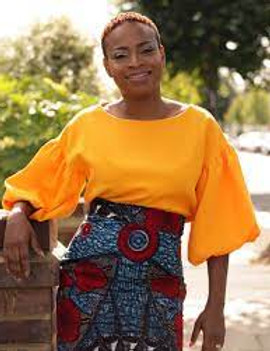
"When her eight-year-old daughter said that she did not feel like emptying the dishwasher, Abi Daré quickly retorted that there were girls of her age in Nigeria who did housework all day for a living.
This exchange followed by her young daughter’s bewilderment became the spark of inspiration that led to her captivating and bold debut novel – The Girl with the Louding Voice.
Abi Daré grew up in a middle-class affluent housing estate in Lagos, Nigeria with an awareness that having a housemaid was the norm. They were often young girls brought in from small villages or neighbouring countries.
She had her own memories of young unkempt girls working in her neighbourhood, but it was not until she had her own daughters that she began to reflect on the reality of the lives these girls led.
Her parents were divorced so she and her brother were raised by their mother, who used her own education and opportunities to ensure her children received the best schooling possible.
After attending the Vivian Fowler Memorial College for Girls in Nigeria, she went to the UK in 2000 and has a law degree from Wolverhampton University, an MSc in International Project Management from Glasgow Caledonian University and more recently, in a bid to improve her writing, attained an MA in Creative Writing from Birkbeck, University of London, where she graduated with distinction. The Girl with the Louding Voice was actually written as part of her thesis.
In 2018, her manuscript won the Bath Novel Award. She later discovered it was the final manuscript to arrive, due to her uncertainty as to whether she should send it.
She currently works full time as the Head of Programme Management for a large medical clinical trial and data intelligence company and lives in Essex with her husband and two daughters.
Abi Daré was deservedly included in New African’s Most Influential Africans listing of 2020. She has lived her life by the wise words of her mother:
'Everything can be taken from you, your health, your money, life sometimes, but if you’re alive and you have an education, that’s the only thing that no one can take from you.'"

The Girl with the Louding Voice

The Guardian Book Review - A Tale to Spark Change
"'Nigeria is a country located in West Africa': so begins the prologue of Abi Daré’s debut novel. The prologue is a brief excerpt from The Book of Nigerian Facts, supposedly published in 2014. Though this book is fictional, the facts it gives are real. It states: 'As the 6th largest crude oil exporter in the world, and with a GDP of $568.5 billion, Nigeria is the richest country in Africa. Sadly, over 100 million Nigerians live in poverty, surviving on less than $1 a day.' It seems a curious place to start a novel. Imagine John Lanchester’s Capital opening with this quote from a 2019 article on the BBC website: 'Overall, London remains the most dangerous part of England and Wales.' Why choose to begin with these facts in particular? Nigeria’s creative industry is worth billions of dollars and provides jobs for thousands. Starting with poverty statistics forces the reader to draw conclusions about Nigeria before they have even begun, telegraphing that their response should be one of pity.
Nevertheless, I turn the page and meet Adunni, our protagonist. Adunni is a 14-year-old girl who lives in a small town several hours’ drive from Lagos. Although she is a minor, she is about to be illegally married off to raise money for her father. Her bride price will be used to pay the family’s rent, among other things. In many ways, her tale is one of woe. Her mother, who championed her right to an education, is dead. She is raped by her 'husband', who has a daughter her age. Through a series of unfortunate events, she ends up in Lagos as the servant of Big Madam. Although called a 'house-girl', she is really a slave because her wages are withheld from her and given to her procurer.
Despite her hardships, Adunni is determined to become a success, and believes that the surest route is by securing a western education. This is a trope used in classic Nigerian children’s books such as Onuora Nzekwu’s Eze Goes to School, and is deployed to good effect here. The reader is given a reason to root for Adunni as through the ups and downs of her journey she rarely loses sight of her ultimate goal of becoming a girl with a 'louding voice'.

What is a louding voice? It appears to be a coinage of Daré’s for a young woman who confidently shares her perspective on the world, backed up by a sound western education. Daré has said of the language in which the book is written: 'Nigerians speak something called pidgin English, and I knew I didn’t want to write in pidgin English because even the very educated people speak pidgin English. I wanted it to be nonstandard English. I could make it Adunni’s. It could be her own English, so to speak.'
The results of this invented English are uneven. Sometimes it yields original and humorous imagery: Big Madam has a 'chest wide like blackboard'. At other times, Adunni’s mangled dialect seems to turn her into an object of fun, both to the reader and also to the book’s other characters, as though she is the butt of a joke she is not aware of.
The narrative is written in the first person. The reader is privy to Adunni’s thoughts and one wonders why she needs to invent a language to think in when she already has one in which she is fluent: throughout the novel she sings in Yoruba and at one point even acts as a Yoruba translator. Why couldn’t Adunni’s interior life be translated from fluent Yoruba into fluent English?
The novel is strongest when dealing with interpersonal relationships, especially between characters of different classes. Kofi, Big Madam’s cook, takes Adunni under his wing. He cowers in front of Big Madam but bosses Adunni around. Adunni also forms a friendship with Tia, a wealthy environmental consultant and doctor’s wife who lives nearby. Tia is privileged and well educated, but naive about the harsh realities of Adunni’s life. Their friendship, in which they exchange knowledge, is one of the highlights of the book.
The story told in this novel is an important one. The trauma of girls forced into marriage and the blight of domestic slavery in Nigeria are both issues that must be brought to light. As Adunni wonders: 'Why are the women in Nigeria seem to be suffering for everything more than the men?' The Girl With the Louding Voice joins a long and fine tradition of issue-led novels that have sparked conversations resulting in social change. Social justice is a laudable intention when writing a novel, yet one also reads them for subtler and less concrete gains."

Author Resources


DRYDEN BOOK CLUB
est. 2001