APRIL 2025 READING
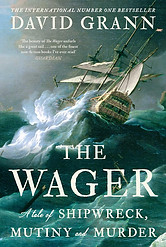
The Wager
by David Grann
Published 2023 Doubleday, 352 pp
ISBN-13 978-0385532460
Book Club Meeting
April 29, 2025, 7:00 pm
Hosted by: Debbie Fisher
Book selected by: Ann Manzano
Snack provided by: Debbie Fisher
Wine provided by: Donna West and Linda LeVan
Accessibility
Print and Large Print
-
Finger Lakes Library System
E-book
-
NY Public Library
-
Finger Lakes Library System
E-Audiobook
-
NY Public Library
-
Audible (Amazon)
CD Audiobook
-
Finger Lakes Library System
David Grann: About the Author

David Grann is a #1 New York Times bestselling author and an award-winning staff writer at The New Yorker magazine.
His newest book, The Wager: A Tale of Shipwreck, Mutiny, and Murder, will be published in April of 2023. With the twists and turns of a thriller, it tells the true saga of a company of British naval officers and crew that became stranded on a desolate island off the coast of Patagonia and descended into murderous anarchy. The book explores the nature of survival, duty, and leadership, and it examines how both people and nations tell—and manipulate—history.
Grann is also the author of Killers of the Flower Moon: The Osage Murders and the Birth of the FBI, which documented one of the most sinister crimes and racial injustices in American history. Described in the New York Times as a “riveting” work that will “sear your soul,” it was a finalist for the National Book Award and a winner of the Edgar Allen Poe Award for best true crime book. It was a #1 New York Times bestseller and named one of the best books of the year by the Times, Wall Street Journal, Washington Post, Los Angeles Times, Entertainment Weekly, Time, and other publications. Amazon selected it as the single best book of the year.
Over the years, Grann’s stories have appeared in The Best American Crime Writing; The Best American Sports Writing; and The Best American Nonrequired Reading. His stories have also been published in the New York Times Magazine, Atlantic, Washington Post, Boston Globe, and Wall Street Journal.
In addition to writing, Grann is a frequent speaker who has given talks about everything from Killers of the Flower Moon and the importance of historical memory to the dangers of complicity in unjust systems, and from the art of writing and detection to the leadership methods of explorers, such as Ernest Shackleton.
Grann holds master’s degrees in international relations (from the Fletcher School of Law and Diplomacy) and creative writing (from Boston University). After graduating from Connecticut College, in 1989, he received a Thomas J. Watson Fellowship and did research in Mexico, where he began his career in journalism. He currently lives in New York with his wife and two children.
The Wager
A Tale of Shipwreck, Mutiny, and Murder

The Wager review: David Grann’s magnificent shipwreck epic
"New masterpiece from the author of Killers of the Flower Moon and The Lost City of Z is as much about literature as adventure."
"In his new book, David Grann tells a classic sea yarn in a new way, overthrowing an old colonial story. Along the way, he charts a course for other tellers of modern adventure tales.
From a distance, 'The Wager' looks like an old-fashioned thing. And in some hands the story might have heaved along like the ship itself: a relic of the 18th century, worn and worm-eaten, wearing only a new coat of paint. But Grann is one of America’s most meticulous narrative nonfiction writers, whether describing a septuagenerian bank robber for the New Yorker, or a French serial impostor, or a man trudging alone across Antarctica.
In 'The Lost City of Z', he told the story of Capt Percy Fawcett, who in the 1920s disappeared into the Amazon searching for a hidden civilization. In Killers of the Flower Moon, he wrote of Oklahoma’s Osage tribe, whose members were murdered for their oil money. Across a span of work writers tend to reveal patterns, purposefully or not, and Grann seems drawn to people too obsessed for their own good, grinding themselves away, so focused on each step they never look up to see the horizon. That pattern holds true in 'The Wager'.
Here’s what Grann gives away, right at the beginning of his tale. We meet the cast of sailors and their officers in the mid-18th century, during the absurd-sounding War of Jenkins’ Ear, so named because it arose from the allegation a Spanish sailor cut off a British sailor’s ear. Really it was a clash of empires, as the British and Spanish grabbed as much of the New World as they could, then snatched it from each other. In 1740, His Majesty’s Ship The Wager set sail across the Atlantic. Its covert mission was to intercept a Spanish treasure ship off the Chilean coast.
The sailors endured hardships as they rounded Cape Horn, where the strongest currents in the world pounded the ship so hard even veterans reeled. That was also where scurvy set in, and typhus. At this early point in the story Grann begins to deviate from the romance of old sea-faring literature. He relates the physical and psychological toll of the voyage.
Grann begins weaving into the story references to older forms of sea poetry and narrative, for reasons that don’t become fully clear until later. As the sailors round the Horn, they see a great albatross and Grann relates the tale of another doomed voyage in the same spot. An officer on that ship shot an albatross, cursing the crew and inspiring Samuel Taylor Coleridge to write 'The Rime of the Ancient Mariner':
And I had done a hellish thing,
And it would work ’em woe:
For all averred, I had killed the bird
That made the breeze to blow.
The Wager aimed for Robinson Crusoe Island, in the Pacific, but shipwrecked instead on a remote island off Patagonia. And there – without giving anything away – the real struggle for survival begins. The two most central figures are Capt David Cheap and the ship’s gunner, John Bulkeley. One an aristocratic officer, the other an intuitive leader. They clash in a deadly contest to win the loyalty of the 145 survivors.
Eventually – again, Grann gives this away early – some of the survivors do return to England. They’re court-martialed, called to present their accounts of what happened aboard 'The Wager' and on the island. Was it really a harrowing but simple tale of survival? Or something more insidious and menacing: mutiny?
That’s when the beauty of 'The Wager' unfurls like a great sail. Grann’s book is not about romance but truth and he has prepared the reader. It’s a story about the stories we tell ourselves – that empires and nations tell themselves – and how they shape us. His literary references suddenly come into focus and lift the book to become something greater than an adventure tale.
Here’s what I mean: earlier in the 18th century another British officer, Alexander Selkirk, found himself marooned off Patagonia. His story inspired Daniel Defoe to write Robinson Crusoe. The men aboard the The Wager placed all their hope on Robinson Crusoe Island, because they knew the novel. Their voyage inspired Melville, who wove elements into his work. During Grann’s research, as he rode in a small boat to Wager Island, he listened to Melville’s Moby-Dick.
We make our stories, until they make us. So many of Grann’s predecessors wrote of colonial adventures in a way that glorified violence, exploitation and enslavement. But recognizing the power of story, Grann seeks to burnish nothing, instead presenting the truth. He fixes his spyglass on the ravages of empire, of racism, of bureaucratic indifference and raw greed. In doing so, he frees himself to acknowledge the valor, the curiosity and the sheer adventure of the age.
There’s an expectation, in reviewing a book like 'The Wager', to balance its strengths with some discussion of its flaws. But 'The Wager' is one of the finest nonfiction books I’ve ever read. I can only offer the highest praise a writer can give: endless envy, as deep and salty as the sea."

DRYDEN BOOK CLUB
est. 2001