NOVEMBER 2026 READING

The Yearling
by Marjorie Kinnan Rawlings
Published by Simon and Schuster, 2002
471 pp
ISBN 978-0743225250
Book Club Meeting:
November 24, 2026, 7:00 pm
Hosted by: Linda LeVan at Village Hall
Snack provided by: Linda LeVan
Wine provided by: Patti Finnerty and Beth Kanalley
Book selected by: Mary Lynch
Accessibility
Print
-
Finger Lakes Library System
Large Print
-
Finger Lakes Library System
E-book
-
Finger Lakes Library System
-
NY Public Library
-
Amazon (Kindle)
E-audio book
-
Finger Lakes Library System
-
Amazon (Audible)
-
NY Public Library
About the Author: Marjorie Kinnan Rawlings

"Marjorie Kinnan Rawlings (1896-1953) was a well-known American writer of the 1930s and ‘40s who drew material for her stories from the rugged Alachua County region and, in particular, a small unincorporated community of Cross Creek, situated about 20 miles southeast of Gainesville. In 1939, her book, The Yearling, won a Pulitzer Prize for fiction. A 1946 movie based on the book and starring Gregory Peck and Jane Wyman won two Academy Awards.
Marjorie was the first-born child to Arthur Frank Kinnan and Ida May Traphagen in Washington, D.C. where her father worked as an attorney for the U.S. Patent Office. By the age of 6, Marjorie was displaying an interest in writing. At 15, she won a prize for her story, "The Reincarnation of Miss Hetty," in a children's' literature contest sponsored by McCall's Magazine.
In 1928, Marjorie Kinnan Rawlings saw Florida for the first time. After receiving a modest inheritance, she and Charles bought a 72-acre orange grove near Hawthorne, Florida, near the tiny hamlet of Cross Creek. The couple remodeled an old Cracker-style house on the place and turned it into a warm and inviting place.
During her two decades at Cross Creek, Rawlings published eight books. By far the most famous was The Yearling, her story of a boy and his love for a deer in Florida's scrub country. The best-selling novel won the Pulitzer Prize of 1939 and brought its author wealth and enduring fame. In 1942, Rawlings–who had a life-long passion and talent for cooking–published Cross Creek Cookery, which became a best-selling cookbook.
In the course of her growing to international stature as a writer, Rawlings became friends with many of the day's literary luminaries, including Ernest Hemingway, Thomas Wolfe, F. Scott Fitzgerald and Zora Neal Hurston, who was Rawlings' occasional guest at Cross Creek.
Rawlings inspired countless young writers and artists throughout her lifetime and her legacy remains popular today. One of her most acclaimed short stories, Gal Young ‘Un, which won first prize in the O. Henry short-story competition of 1932, was made into an acclaimed feature film by Florida-based independent filmmaker Victor Nunez in 1979. A film based largely on Rawlings' 1942 memoir, Cross Creek, was released in 1983 starring Mary Steenburgen in the role of Rawlings. Shot entirely in Florida, the film received four Academy Award nominations. A postage stamp made in her honor was released by the U.S Postal Service in 2008."
Marjorie Kinnan Rawlings
Historic State Park

The Yearling

Literary Ladies Guide Review
"'The Yearling', a 1938 novel by Marjorie Kinnan Rawlings (1896 – 1953), was the most successful work by this American author. It was an immediate bestseller and won the Pulitzer Prize for fiction in 1939.
Rawlings struggled to gain a foothold in the literary world and made no secret that she found writing to be a difficult task. After buying an orange grove in Cross Creek, Florida, where she subsequently lived for many decades, she found the inspiration she had long sought from the local culture and landscape.
'The Yearling' might now be considered more of a young adult novel, though at the time, this was not yet a separate genre. However, it’s a book for readers of all ages. It can be enjoyed as a great narrative coming-of-age story, or read as a parable.
Following is a wonderfully descriptive review of 'The Yearling' from 1938, the year it came out. Note that it reveals key plot points, none of which aren’t already well known and much discussed in reviews. So if you prefer to be surprised, read the book before perusing any reviews."

"A 1938 review of The Yearling by
Marjorie Kinnan Rawlings"
"An exerpt from the original review of The Yearling in The Detroit Free Press, April 10, 1938: Marjorie Kinnan Rawlings Tells a Powerful Story of a Boy Growing into Manhood
"A novel of Florida, the story has nothing in common with the Florida of Palm Beach and Miami. It is a tale of the virtual pioneering whic'hammocks,' its higher, drier spots like the fictional Baxter’s Island.
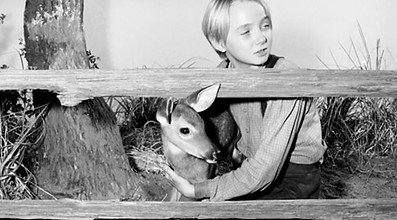
The title refers to the young boy, Jody Baxter, who approaches manhood in the single year of the story’s compass; although there is another yearling, the orphan fawn that Jody brings in from the wilderness. The affection for the fawn, Flag, is regarded by some readers as too sentimental in its treatment by Rawlings.
While we may agree that Jody’s devotion to Flag has moments that are a little tiresome, this very reaction proves the soundness of Rawlings’ emphasis. What adult in real life can maintain unfailing interest in any adolescent passion, whatever it may be?
The best many a parent can achieve is a polite tolerance.
It’s not enough to dismiss the fawn’s existence in the story as a pretty device. As the baby fawn grows into a yearling, according to its nature, it becomes a menace to the hard-won livelihood of the Baxters, Pa, Ma, and Jody.
Twice, Flag eats the succulent green shoots of the new corn and ruins the crop. Twice, Jody’s faith in Flag is put to the test. The boy works harder than he ever has in his young life to protect Flag from the judgment of his understanding father and his more matter-of-fact mother."
"Throughout the story the point is made that Penny Baxter, a confederate veteran who is Jody’s father is a wise huntsman who never kills game except to meet his own needs. Penny has always sympathized with Jody’s wish for something of his very own, just as his old hound, Julia, has shadowed his own footsteps.
But the laws of human need and survival are stern. The moment comes, at the end, when Penny insists that Jody kill his pet. Jody refuses. Penny is ailing and cannot hold a gun. Ma Baxter, a poor shot, wounds Flag, and Jody is forced to end the animal’s misery. Then he runs away, convinced that even his father has betrayed him.
Penny had done what many another parent has tried to do — shield a beloved child from the sorrows and hardships of life. But when thing was no longer possible, he could only tell the boy that 'life knocked a man down and he gets up and it knocks him down agin’ … But ever’ man’s lonesome. What’s he to do then? What’s he to do what he gits knocked down? Why, take it for his share and go on.'
'The Yearling' is a superb study of adolescence, which should deepen the sympathies of all who have any dealings with the young."
Additional Resources
-
Wikipedia on "The Yearling"
-
Read or listen to NPR WSKG All Things Considered "Movies, On Location: The Central Florida of 'The Yearling'"
-
Rogers Movie Nation classic film review "The Yearling"
-
Florida Dept of State Division of Arts & Cuture, Florida Artists Hall of Fame: Marjorie Kinnan Rawlings
-
Goodreads Constant Reader discussion, Classics Corner "The Yearling by Marjorie Kinnan Rawlings Spoilers/Discussions"
-
Literary Ladies Guide Archive Dedicated to Classic Women Authors and their Work "The Yearling by Marjorie Kinnan Rawlings (1938)"
-
YouTube Presentations from the 37th Annual Marjorie Kinnan Rawlings Conference in DeLand, Fl, April 17-18, 2026

DRYDEN BOOK CLUB
est. 2001